
EASA publishes guide on AI transparency in advertising
22 October 2026
New Guide provides a practical and proportionate framework for disclosing advertising generated or enhanced with artificial intelligence
Brussels, 22 October 2026 – The European Advertising Standards Alliance (EASA) today publishes its Guide on Disclosing Ads Generated or Enhanced with Artificial Intelligence, providing advertising self-regulatory organisations and the wider advertising ecosystem with a common framework for approaching AI transparency in commercial communications.
The EASA Guide on Disclosure for AI-generated or AI-enhanced ads is a non-binding resource primarily designed to support advertising self-regulatory organisations (SROs) active in the EU Single Market in developing local guidance, while helping stakeholders across the advertising value chain navigate this complex issue.
Artificial intelligence is increasingly embedded throughout advertising production, from ideation and creative development to the final execution of an advertisement. This creates new opportunities for creativity and innovation, but also raises important questions about authenticity, transparency and the information consumers need to understand the commercial content they see.
The new EASA Guide responds to this rapidly evolving landscape by bringing together the experience of advertising self-regulatory organisations, industry representatives and digital players. Its objective is to help build a coherent approach that protects and informs consumers while preserving advertising creativity and impact.
Transparency that is meaningful, not automatic
At the heart of the Guide stands the principle that AI transparency should be meaningful and proportionate.
EASA has consistently cautioned that indiscriminate disclosure of AI involvement could result in excessive labelling, ultimately creating consumer fatigue and reducing the usefulness of disclosures themselves. Instead, transparency measures should focus on situations where disclosure provides meaningful information to consumers.
The Guide therefore examines the question of disclosure through both the applicable regulatory framework and established self-regulatory principles. It covers the regulatory context, existing self-regulatory and industry practices, the principles that can inform decisions about disclosure, and practical considerations around how to disclose.
Importantly, disclosure of AI use does not replace the fundamental requirement that advertising must never mislead consumers. The Guide makes clear that an advertisement may still be misleading under applicable legal or self-regulatory rules even where the involvement of AI has been disclosed.
Self-regulation translating principles into practice
The publication comes as the advertising ecosystem adapts to the transparency framework established under the EU AI Act and the European Commission’s related Guidelines.
EASA has been closely involved in the policy discussions surrounding the implementation of these requirements and has advocated for solutions that recognise sector-specific practices.
The Guide is deliberately not a compliance instrument, a legal interpretation, or a binding recommendation. Rather, it is intended as a practical compass for SROs and stakeholders navigating AI transparency in the EU Single Market.
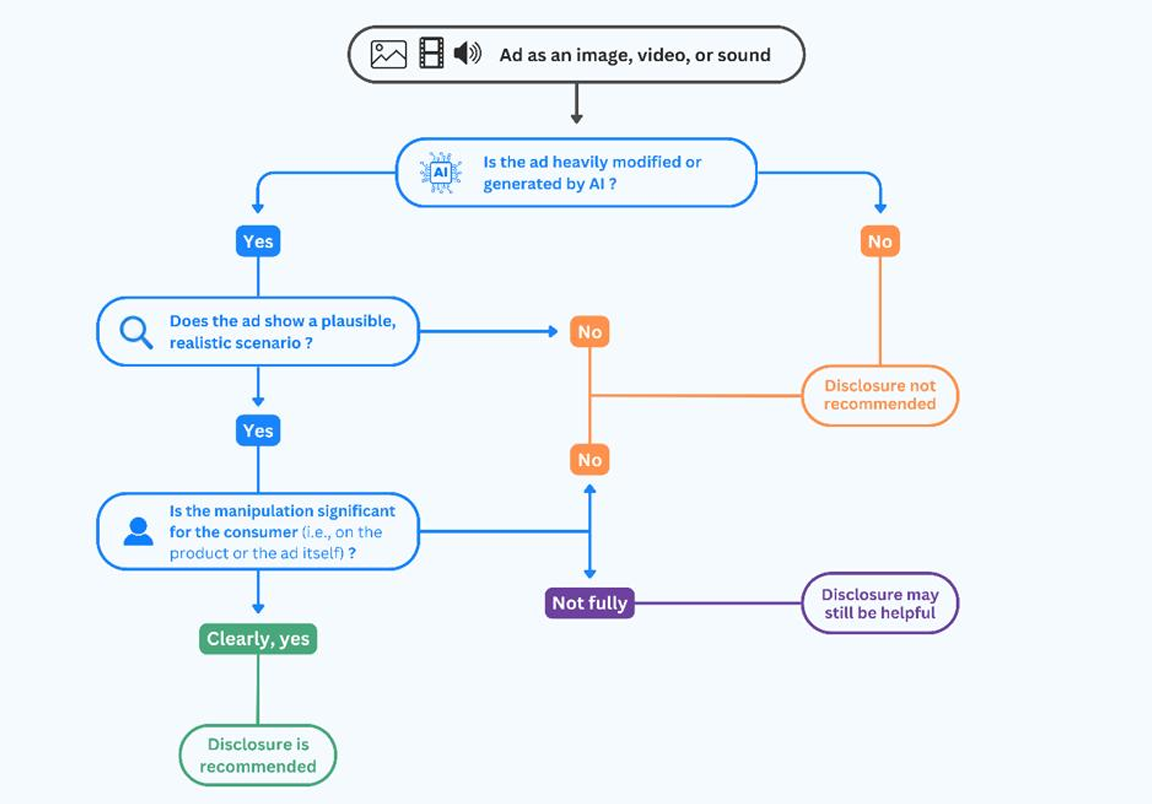
The Guide introduces a graduated, risk-based approach to AI disclosure. It assesses advertisements across three cumulative dimensions: the level of AI use, the plausibility or authenticity of the content, and its significance or potential impact on the consumer. Each can range from low to high: where AI use is limited, the content is clearly fictional, or the manipulation is insignificant to consumers, disclosure is generally not recommended; where the assessment falls into a grey area, disclosure may be helpful; and where AI is used extensively to create realistic content that is significant enough for consumers to potentially perceive it as authentic or true, disclosure is recommended. In short, the more the AI manipulation, the more realistic the result, and the greater its significance for the consumer, the stronger the case for disclosure.
Ludovic Basset, Director General of EASA, said:
“Artificial intelligence is transforming advertising, but the fundamental objective remains the same: consumers should be able to trust the ads they see.
Transparency has an important role to play, but more labels do not automatically mean better information. What matters is providing consumers with meaningful transparency where it is relevant, while preserving the creativity and innovation that AI can bring to advertising.
With this Guide, the European advertising self-regulatory network is translating broad principles into an advertising-specific framework. It demonstrates precisely where self-regulation adds value: responding quickly to technological change, complementing regulation, and turning principles into practical solutions.”
Built collaboratively, designed to evolve
The Guide is the result of work undertaken through EASA’s AI Working Group and received the general support of its members before being submitted to the wider EASA network. It was formally presented to EASA’s Board on 16 October as the final Working Group output and an official public-facing EASA resource.
EASA intends the Guide to remain responsive to technological, regulatory, and market developments.
Download the EASA Guide on Disclosing Ads Generated or Enhanced with Artificial Intelligence here.
Notes to editors
About the Guide
The EASA Guide on Disclosure for AI-generated or AI-enhanced ads addresses the regulatory framework, relevant self-regulatory guidance and industry practices, principles for approaching AI disclosure, and practical considerations concerning how disclosures can appear. It also contains an annex referencing existing industry and SRO guidance and recommendations.
The Guide is non-binding and is primarily intended to support advertising self-regulatory organisations in the EU Single Market in developing their own local approaches, while also helping stakeholders across the advertising value chain navigate AI transparency.
About EASA
The European Advertising Standards Alliance (EASA) is the single European voice for advertising self-regulation. Advertising self-regulation helps ensure that advertising is legal, decent, honest and truthful, contributing to consumer trust in advertising and brands.
Media contacts
Clara Morga, Junior Communications Officer: clara.morga@easa-alliance.org
Guilia Bazzano, Senior Communications Officer – Communications Lead: giulia.bazzano@easa-alliance.org